

Digital Transformation Market Expected to Achieve a Strong 19.8% CAGR, to Reach USD 2.15 Trillion by 2035
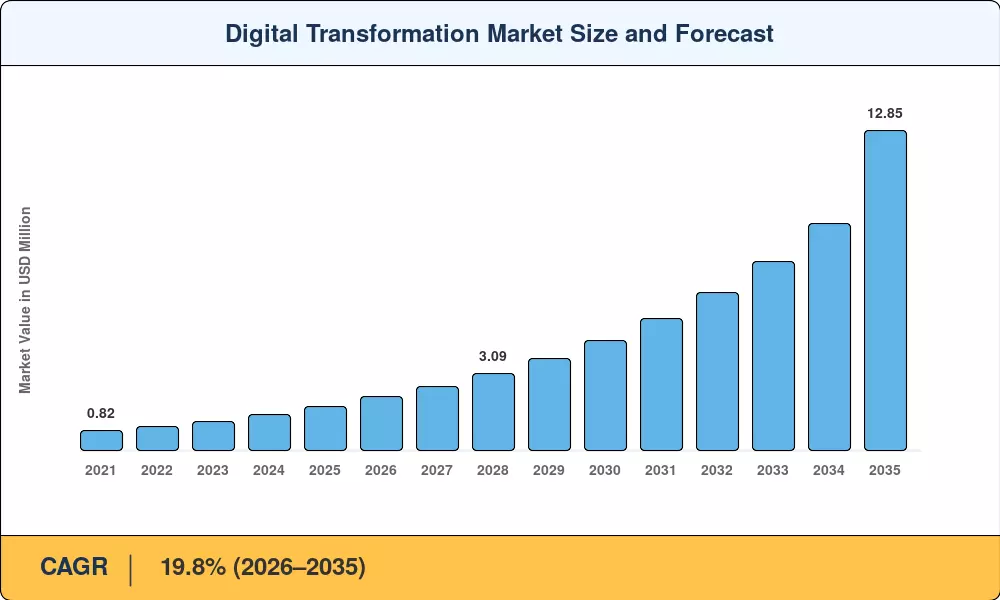
Digital Transformation Market
Digital Transformation Market is accelerating as organizations adopt AI, cloud, IoT, and automation to improve efficiency, agility, and customer experiences
Digital transformation is reshaping industries by integrating AI, cloud, analytics, and automation, enabling smarter decisions, operational excellence, and sustainable growth.”
PARIS, PARIS, FRANCE, June 23, 2026 /EINPresswire.com/ -- The digital transformation market was valued at approximately USD 1.76 trillion in 2025 and is projected to reach USD 2.15 trillion in 2026 before climbing to an estimated USD 12.85 trillion by 2035. This extraordinary expansion reflects a compound annual growth rate (CAGR) of roughly 19.8% during the 2026–2035 forecast window. — Market Research Future
What makes this growth trajectory so compelling?
It is not merely about adopting new software or migrating to the cloud. Digital transformation represents a fundamental rethinking of business models, organizational culture, and value delivery. From artificial intelligence and machine learning to the Internet of Things (IoT) and blockchain, enterprises are weaving advanced technologies into the very fabric of their operations. The result is a market that spans solutions, services, consulting, and infrastructure, touching virtually every sector of the global economy.
Market Dynamics: Drivers, Restraints, and Opportunities
Key Drivers
Several powerful forces are propelling the digital transformation market forward:
Surging Demand for Operational Efficiency. Organizations are under relentless pressure to do more with less. Automation, predictive analytics, and intelligent process management help businesses streamline workflows, reduce human error, and accelerate decision-making. The push toward hyper-automation, where every phase of operation is optimized through technology, is becoming the new standard rather than an exception.
Download Exclusive Sample Copy of This Report Here -
https://www.marketresearchfuture.com/sample_request/8685
Cloud-First and AI-Powered Strategies Cloud computing remains the backbone of digital modernization, offering the scalability, flexibility, and cost efficiency that legacy systems simply cannot match. By 2027, more than half of all enterprises are expected to adopt industry-specific cloud platforms. Meanwhile, artificial intelligence, particularly generative AI and agentic AI is moving from experimental to production-grade, with over 80% of enterprises projected to deploy GenAI-enabled applications by 2026.
Evolving Customer Expectations Today's consumers demand seamless, personalized, and instant interactions across every touchpoint. Businesses that fail to deliver frictionless digital experiences risk losing market share to more agile competitors. This customer-centric imperative is driving massive investment in digital channels, data analytics, and omnichannel platforms.
Government and Regulatory Support Across the globe, governments are actively promoting digital adoption through funding, policy frameworks, and infrastructure investment. Initiatives like the EU Digital Decade, China's "Digital China" strategy, and Industry 4.0 programs in Germany are creating fertile ground for market expansion.
Get a Sample PDF of the Report at -
https://www.marketresearchfuture.com/sample_request/8685
Major Restraints
Despite the optimistic outlook, the market faces notable headwinds:
Talent and Skills Shortages: A staggering 67% of digital transformation initiatives experience delays due to IT skill gaps. Finding professionals proficient in AI, cloud architecture, cybersecurity, and data science remains one of the biggest challenges for enterprises worldwide.
Legacy Infrastructure Inertia: Many established organizations are burdened by outdated systems that are deeply embedded in their operations. Migrating from these monolithic architectures to modern, composable platforms requires significant capital, time, and organizational change management.
Data Privacy and Security Concerns As digital footprints expand, so do vulnerabilities. Strict data protection regulations such as GDPR in Europe and evolving frameworks in Asia-Pacific add complexity and compliance costs. Organizations must balance innovation with robust cybersecurity and ethical data governance.
Emerging Opportunities
The market is ripe with untapped potential:
• Small and Medium Enterprises (SMEs): While large enterprises currently dominate spending, the SME segment is growing at an accelerated pace, driven by affordable cloud solutions and government support programs.
• Healthcare Digitalization: Telehealth, smart hospitals, and AI-driven diagnostics represent one of the fastest-growing application areas.
Key Players and Competitive Insights
The digital transformation arena is intensely competitive, characterized by both technology giants and specialized service providers. Leading players include Microsoft Corporation, Amazon Web Services (AWS), Alphabet Inc. (Google Cloud), IBM Corporation, SAP SE, Oracle Corporation, Dell Technologies, Accenture PLC, Capgemini SE, Tata Consultancy Services (TCS), and Infosys Limited.
These organizations are differentiating themselves through:
• End-to-end solution portfolios spanning cloud, AI, IoT, and cybersecurity
• Strategic acquisitions to expand creative and digital product capabilities (e.g., Accenture's acquisition of Work & Co. to bolster Accenture Song)
• Industry-specific offerings tailored to BFSI, healthcare, manufacturing, and retail verticals
• Partnership ecosystems that combine telecom expertise with managed infrastructure and AI platforms (e.g., Masorange and Kyndryl's collaboration in Europe)
The competitive landscape also witnesses the rise of niche players focused on agentic AI, quantum computing readiness, and edge analytics creating a rich tapestry of innovation that benefits end users.
Market Segmentations
The digital transformation market can be dissected across multiple dimensions:
By Technology
• Cloud Computing: Dominant force, with segments including IaaS, PaaS, and SaaS
• Artificial Intelligence & Machine Learning: Fastest-growing segment, encompassing NLP, computer vision, and predictive analytics
• Internet of Things (IoT): Led market share in 2025, particularly in manufacturing and healthcare
• Big Data & Analytics: Accounted for over 35.7% revenue share in 2025
• Blockchain: Emerging as the most opportunistic segment for security and transparency applications
By Deployment
• Cloud-Based/Hosted: Expected to capture 64.1% market share by 2035, growing at a CAGR of 30.5%
• On-Premises: Still preferred by organizations with stringent data sovereignty and security requirements
By Organization Size
• Large Enterprises: Currently hold over 58.7% of market revenue, driven by substantial R&D budgets
• SMEs: Projected to grow at a CAGR of 28.4%, fueled by accessible SaaS models and digital inclusion initiatives
By End-Use Industry
• BFSI (Banking, Financial Services, Insurance): Leading vertical with approximately 30% market share, driven by fintech innovation and digital payment adoption
• Healthcare: Fastest-growing sector, propelled by telemedicine, smart hospitals, and AI diagnostics
• Retail & E-Commerce: Growing at 26.9% CAGR, focused on omnichannel experiences and personalized marketing
• Manufacturing: Industry 4.0 adoption, digital twins, and predictive maintenance are key growth catalysts
Browse In-depth Market Research Report:
https://www.marketresearchfuture.com/reports/digital-transformation-market-8685
Regional Insights
North America
North America commands the largest share of the global market, approximately 42–44% in 2025, and is expected to maintain dominance through 2035. The United States, in particular, benefits from mature digital infrastructure, early cloud adoption, advanced AI research, and a robust ecosystem of technology innovators. Strong government support for automation in healthcare, automotive, and pharmaceutical sectors further cements the region's leadership.
Europe
Europe holds a substantial market share, underpinned by strategic policy initiatives such as the EU Digital Strategy, the European Data Act, and the Chips Act. Germany leads regional adoption through its Industry 4.0 focus, while the UK, France, and Nordic countries are investing heavily in AI and cloud sovereignty. The European Commission's expansion of AI Factories across member states signals a long-term commitment to digital competitiveness.
Asia-Pacific
Asia-Pacific is the fastest-growing region, with a projected CAGR of 29.5% between 2026 and 2035. China, India, Japan, South Korea, and Singapore are at the forefront, driven by government digitalization schemes, aggressive 5G rollouts, and a young, digitally native population. The Asian Development Bank's partnerships with organizations like GSMA are accelerating mobile connectivity and digital inclusion across the region.
Latin America, Middle East & Africa (LAMEA)
While smaller in absolute terms, the LAMEA region is experiencing significant growth as investments in advanced technology and digital infrastructure increase. Rising demand from end-use sectors and public-private collaboration are creating new avenues for market participants.
Recent Developments
The digital transformation landscape continues to evolve at a breakneck pace:
• October 2025: Deutsche Telekom and NVIDIA launched Germany's Industrial AI Cloud, a USD 1.16 billion initiative featuring SAP integration to accelerate industrial AI adoption across Europe.
• October 2025: The European Commission announced the expansion of its AI Factories network, adding six new sites across the Czech Republic, Lithuania, the Netherlands, Romania, Spain, and Poland.
• March 2025: VAST Data partnered with Partisia to launch VAST InsightEngine integrated with NVIDIA DGX systems, delivering a turnkey enterprise AI stack for real-time data ingestion and GPU-optimized inferencing.
• July 2025: The Asian Development Bank and GSMA signed a multi-year cooperation agreement to drive digital development across Asia-Pacific, focusing on mobile connectivity, policy reform, and capacity building.
These developments underscore a clear trend: digital transformation is no longer a siloed IT initiative. It is a strategic, cross-functional imperative that demands collaboration between technology providers, governments, and enterprises.
➤ FAQs:
Q1: What exactly is digital transformation?
Digital transformation is the strategic integration of digital technologies—such as cloud computing, AI, IoT, and data analytics into all areas of a business. It fundamentally changes how organizations operate, deliver value to customers, and compete in the marketplace.
Q2: How big is the digital transformation market?
The market was valued at approximately USD 1.76 trillion in 2025 and is projected to reach USD 12.85 trillion by 2035, growing at a CAGR of around 19.8%.
Q3: Which industries are driving the most demand?
BFSI leads in market share (around 30%), followed by healthcare, retail, manufacturing, and telecom. Healthcare is currently the fastest-growing vertical due to telehealth and smart hospital adoption.
Q4: What are the biggest challenges companies face?
The primary obstacles include IT talent shortages (affecting 67% of initiatives), legacy system complexity, data security concerns, and the high costs of organizational change management.
Q5: Which region offers the best growth opportunities?
While North America leads in market size, Asia-Pacific offers the highest growth potential with a projected CAGR of 29.5%, driven by rapid digitalization in China, India, and Southeast Asia.
Q6: Is digital transformation only for large enterprises?
Not at all. While large enterprises currently hold the majority share, SMEs are the fastest-growing segment. Affordable cloud solutions, SaaS platforms, and government incentives are making digital transformation accessible to businesses of all sizes.
Q7: What technologies should businesses prioritize?
Cloud computing, AI/ML, IoT, and advanced data analytics form the core technology stack. Emerging areas like agentic AI, composable architecture, and blockchain are also gaining significant traction.
➤➤ Latest Market Intelligence from Market Research Future:
Adaptive Learning Market -
https://www.marketresearchfuture.com/reports/adaptive-learning-market-10478
Partner Relationship Management Market -
https://www.marketresearchfuture.com/reports/partner-relationship-management-market-10569
Video As A Service Market -
https://www.marketresearchfuture.com/reports/video-as-a-service-market-10614
Intelligent Document Processing Market -
https://www.marketresearchfuture.com/reports/intelligent-document-processing-market-10629
Railway Cybersecurity Market -
https://www.marketresearchfuture.com/reports/railway-cybersecurity-market-10707
Internet Of Senses Market -
https://www.marketresearchfuture.com/reports/internet-of-senses-market-10747
Blockchain In Smart Home Market -
https://www.marketresearchfuture.com/reports/blockchain-in-smart-home-market-10788
Smart Toys Market -
https://www.marketresearchfuture.com/reports/smart-toys-market-10813
Video Processing Platform Market -
https://www.marketresearchfuture.com/reports/video-processing-platform-market-10814
Augmented And Virtual Reality Hardware Market -
https://www.marketresearchfuture.com/reports/augmented-virtual-reality-hardware-market-10965
Sagar Kadam
Market Research Future
+1 628-258-0071
email us here
Visit us on social media:
LinkedIn
Facebook
X
Legal Disclaimer:
EIN Presswire provides this news content "as is" without warranty of any kind. We do not accept any responsibility or liability for the accuracy, content, images, videos, licenses, completeness, legality, or reliability of the information contained in this article. If you have any complaints or copyright issues related to this article, kindly contact the author above.
